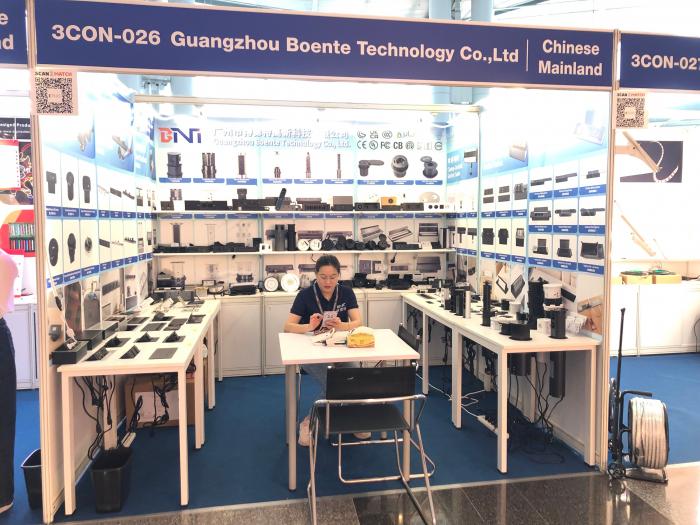
Short answer: before specifying a pop-up desk socket, fix five things in this order — cut-out diameter, lift mechanism, port configuration, certification for the destination market, and the cable route under the table. Get those wrong and the unit either will not fit the furniture or will fail inspection. This guide walks through each decision, and points to units on display at HKTDC Hong Kong International Lighting Fair 2026, booth 3CON-026, 27–30 October.

The five decisions that determine the specification
| Decision | What it controls | Typical options |
| Cut-out diameter | Whether the socket fits the table at all | 42 mm, 60 mm, 70 mm, 85 mm, 98 mm |
| Lift mechanism | How it opens, service life, cost | Pneumatic, motorised, flip lid, sliding cover |
| Port configuration | What can be charged without an adapter | AC outlets + USB-A / USB-C / wireless pad |
| Certification | Whether it can be sold or installed legally | CE, UKCA, CB, FCC, KC, RoHS |
| Cable route | Installation time and cable management | Bottom exit, side exit, supplied length |
1. Cut-out size decides the furniture, not the socket
The cut-out is the constraint you cannot change later. A 42 mm hole and a 98 mm hole belong to different furniture designs, and enlarging a finished top on site is rarely acceptable on veneer or solid surface. Decide the cut-out before the worktop drawing is signed off.
Small grommets in the 42–60 mm range suit hotel room desks, sofa-side tables and study desks where a single device is charged. Units in the 85–98 mm range carry four AC outlets plus USB and are aimed at meeting tables and shared workstations. Examples at the fair include the 42 mm recessed USB charger, the 70 mm desk grommet with wireless charging, the 85 mm pop-up socket with four AC outlets and the 98 mm pneumatic pop-up socket.
One practical check: ask for the cut-out drawing, not just the diameter. Round holes and rectangular holes with the same nominal size are not interchangeable, and the flange diameter determines how much margin you need around the hole.
2. Pneumatic, motorised, flip or slide
Pneumatic units release on a press and rise on a gas spring. There is no actuator to fail and no power draw when closed, which is why they dominate high-traffic meeting tables. The trade-off is that the spring is a wear part and the feel changes over years of use.
Motorised units open on touch and close under power. They suit conference tables where the unit is raised dozens of times a day and where the surface must sit perfectly flush when closed. The motorised pop-up socket with four AC outlets and wireless charging is the reference example on the stand.
Flip lids and sliding covers are the cheapest way to hide power, and they fail in the simplest way: the hinge or the slide track. They are the right choice for hotel desks and residential furniture where the socket is opened a few times a day, not for a shared meeting room.
3. Ports: count devices, not ports
Specify from the devices that will actually be plugged in. A meeting table typically needs one AC outlet per seat plus two or three USB ports; a hotel desk needs one AC outlet, one USB-A and one USB-C. Wireless pads are useful only where phones are set down flat — they add cost and height, and they are not a substitute for a USB-C port.
Watch the USB power budget. A port labelled USB-C is not automatically a fast-charging port; the wattage matters. Where laptops are charged from the table, look for USB-C PD output rather than 5 V charging, and check whether the total output is shared across ports.
4. Certification follows the destination, not the factory
The same socket can be sold in the EU and refused in the UK if the plug type and marking are wrong. For Europe, CE marking with a declaration of conformity and RoHS compliance is the baseline. For the UK, UKCA marking applies. For North America, UL or ETL listing is what an inspector will look for. Korea requires KC, and CB reports are the common route to several of these at once.
At the fair, certification marks including CE, CB, FCC and KC are displayed on the stand graphics. Buyers should still ask for the certificate numbers and the test report for the exact variant being ordered, because certification is granted per configuration, not per product family.
For reference, the underlying standards are published by the IEC for socket-outlets (IEC 60884) and by national bodies for plug types such as BS 1363 in the UK.
5. Table thickness and the cable route
Most pop-up bodies need 45–70 mm of clear depth below the surface, and the clamp or fixing ring needs access from underneath. On a 25 mm top over a drawer pedestal, that space may not exist. Confirm three dimensions before ordering: top thickness, clear depth under the top, and the distance to the nearest obstruction.
Cable exit matters as much as cable length. A bottom-exit unit drops the cable straight into the cable tray; a side-exit unit needs a route to the edge. Where the table has a flip-up cable spine, the socket cable should run in the same channel rather than across the knee space.
What to check in person at booth 3CON-026
Photographs do not show the two things that decide whether a pop-up socket feels right: the speed of the lift and the sound it makes. At the stand, open and close each mechanism several times, press the closed lid to check for rock, and look at the gap between the lid and the table surface. Then check that the USB ports are reachable with the unit open and a plug inserted in the adjacent AC outlet — a common layout failure.
Full stand details are in the HKTDC 2026 exhibitor announcement.
The stand is at booth 3CON-026 in the Chinese Mainland pavilion at the Hong Kong Convention and Exhibition Centre, 1 Expo Drive, Wan Chai, from 27 to 30 October 2026. Fair details are published on the HKTDC fair page. Product specifications are available at boentes.com.
Frequently asked questions
What is a pop-up desk socket?
A pop-up desk socket is a power and charging unit mounted into a table top that rises or opens when needed and sits flush when closed. It typically combines AC outlets with USB-A, USB-C or wireless charging, and is used on office desks, meeting tables, hotel room desks and kitchen worktops.
What cut-out size do I need for a pop-up socket?
Cut-out size follows the unit: small grommets use 42–60 mm holes, mid-size units use 70–85 mm, and four-outlet pop-up bodies commonly use 98 mm. Confirm the shape (round or rectangular) and the flange diameter as well as the nominal size.
Is pneumatic or motorised better?
Pneumatic is simpler and has no electrical actuator, so it suits high-traffic tables where reliability matters more than feel. Motorised gives a consistent touch-open action and a flush finish, and suits conference tables where the unit is used many times a day.
Can a pop-up socket be retrofitted to an existing desk?
Yes, if the top can be cut and there is clear depth below it. Clamp-on and screw-mount units avoid a large cut-out and are the usual choice for retrofit work; flush pop-up bodies need the full cut-out and access from underneath.
Which certifications should I ask for?
Ask for the certificate that matches the destination market — CE and RoHS for the EU, UKCA for the UK, UL or ETL for North America, KC for Korea — and request the test report for the exact variant, plus CB reports where multi-market approval is planned.
Where can I see these products at HKTDC 2026?
Guangzhou Boente Technology is exhibiting at booth 3CON-026 in the Chinese Mainland pavilion at the Hong Kong Convention and Exhibition Centre, 27–30 October 2026.
 Send Email
 Ivy Lee
 QQ
 Fannyfenfen
 Trade Manager
 19700210860